Students in Mark Lord's 2013 ENDGAMES course share resources and thinking here.

Tuesday, February 26, 2013

We're waiting for Godot.


1) What was French classism and social structure like in the time in which the play was published?  What was the political scene like at the time that could have possibly had an influence on the work itself?

2) Does the juxtaposition of the physical realities of Didi and Gogo (the five senses, i.e. pain) with the seeming lack of metaphysical elements (time, memory, etc.) serve to highlight certain themes within the text? If so, what? Additionally, how have prior productions dealt with this juxtaposition?

3) What are the “rules” of the play? How have prior productions dealt with the “rules” of such elements as the passage of time, character relationships, etc. and how can we incorporate those “rules” or new “rules” into our production?

4) What does this text look like in the original French? Is there a preference for the use of “masculine” words in the original text?

5) Why is this play relevant for our audience? Do we need to find a theme, such as the New Orleans production, to use as a lens to view the play through to continue to make it relevant for audiences? If we do need to find a “theme,” what would it be?

6) Is there any literature that is written on the similarities between the pairing of Didi/Gogo and Hamm/Clov or the similarities between the language used in the interactions between the two sets of characters?  If so, are there over-arching themes between Waiting for Godot and Endgame (or any of Beckett’s other works)?

Godot dramaturgy questions

So sorry these are so late.

Some musings:

-How can we track the decay of these characters' bodies in relation to the play? Going off our questions re: time, it seems to me one of the more reliable markers of time is how the characters interact with their bodies: how Pozzo decays from sighted to sightless, how Estragon registers his wounds.
         -Is such decay "significant" somehow, thematically? Or symbolically? Or should we just take it as "decay?"

-Who are the pugnacious "they" and why do they beat up Estragon/Vladimir?
         -Is this in any way connected to something autobiographical? Beckett's own time sequestered in the countryside? (Probably reading a bit too much into that one)

-What is the landscape of the play? We know that it's a "country road" with "a tree" at "evening." Does anything surround this tree? Is there a soundscape? Are there critters? How far are they from those locations in France Kat/they mention?

-What is the nature of Vladimir and Estragon's relationship? We know they have known each other for a long time. Are they friends? Are they brothers? Are they lovers? Did they transition between these relationship (friends to lovers, brothers to friends, lovers to friends, brothers to lovers (!ack!))?
         -For that matter, what is the exact nature of Pozzo and Lucky's relationship? Is it slave/master, or servant/master? How did this come to be? How does the nature of their relationship affect the world of the play?

-How can we explore the comedy of this play? Is it vaudevillian? Lecoq? None of the above?
         -To what extent can we/should we imbue the play with contemporary stylistic elements? I'm thinking about the Classical Theatre of Harlem production; the NY Times review I read mentioned that the production "owed debts" to rap. Would such contemporary elements overdetermine the setting/Godot somehow?

And, of course, some of the questions we brought up in class last week:
         -Why do this play? How does it relate to us? To our audience? To our theater company? Does it resonate with us philosophically? Aesthetically? Politically? Topically?
                   -What does it mean for this play to be "political?" Does imbuing the play with contemporary politics "overdetermine" Godot? If so, do we mind?
         -Should we/How can we explore the difference between the specificity of Beckett's stage directions (Estragon's boots, musing on the struggle, watching the sun set) and the ambiguity of an audience's perspective?

ESTRAGON: ...Stay With Me!

--> -Tenderness in Godot
[...ESTRAGON wakes with a start. Jumps up, casts about wildly. VLADIMIR runs to him, puts his arms around him.] VLADIMIR: There...there... Didi is there... don't be afraid...
Why does this play appear to have substantially more inter-character tenderness?


How mutually beneficial is the relationship between Pozzo and Lucky?


How do audiences respond to productions of Godot that err on the side of indefinite setting and non-politicization?
How does/does one “read” a production in which Godot is predetermined differently from one in which he/she/it is not?


Who is “Mr. Albert”? (85)
What role does the BOY play in the [determination of the] physics of this world? Is he in a position of dominion? Does the boy age? Why doesn't Godot dye his beard?


Why will he never let him sleep?


What has Pozzo got to prove?


Didi...Afraid...Dreams...Why...?...


VlADIMIR: Suppose we got up to begin with.
ESTRAGON: No harm in trying.
[They get up]
ESTRAGON: Child's play.
VLADIMIR: Simple question of will-power. (78)


Why do these passages jump out at me so?


VLADIMIR: ...it's the way pf doing it that counts, the way of doing it, if you want to go on living. (55)


ESTRAGON: We always find something, eh Didi, to give us the impression we exist?
VLADIMIR: Yes yes, we're magicians. But let us persevere in what we have resolved, before we forget. (64)


VLADIMIR: You must be happy too, deep down, if only you knew it.
ESTRAGON: Happy about what?
VLADIMIR: To be back with me again.
ESTRAGON: Would you say so?
VLADIMIR: Say you are, even if it's not true.
ESTRAGON: What am I to say?
VLADIMIR: Say, I am happy.
ESTRAGON: I am happy.
VLADIMIR: So am I.
ESTRAGON: So am I.
VLADIMIR: We are happy.
ESTRAGON: We are happy. [Silence] What do we do know, now that we are happy?
VLADIMIR: Wait for Godot. (56)


-And particularly this'n:


POZZO: [Suddenly furious] Have you not done tormenting me with your accursed time! It's abominable! When! When! One day, is that not enough for you, one day like any other day, one day he went dumb, one day I went blind, one day we'll go deaf, one day we were born, one day we shall die, the same day, the same second, is that not enough for you? [Calmer] They give birth astride of a grave, the light gleams for an instant, then it's night once more. [He jerks the rope.] On!

Cheers,

-Jo


Ponderings


1) Where is the play set? And furthermore, what time period is it set in?

2) I'm interested in what hats signify to Beckett. I have seen them in each of the plays that we have read and they are always there and noted. Is it a sign of masculinity? If we don't know when these plays are set, we cannot just say that it is a result of the time period or common in the area because we do not know where they are set either.

3) I also want to know more about loyalty/slavery. Why does lucky stay with pozzo even when he has opportunities to escape? We see that also in Endgame, why doesn't Clov leave Hamm when he has the ability to and he is unhappy with him? Is it just loyalty? Is it slave mentality? I s it the closest show of love that exists in these worlds?

4) How do the stage directions play a role in Godot? How do they create the absurd and grotesque that we associate with Beckett plays?

5) Forgetting is a common theme in the play and in Beckett in general. I want to know if in Godot it is a result of deterioration, because that is what i think it is. Or is it an issue of aging. This is why I would like to know what the ages of did and gogo are.

6) Where does the inspiration for the names of Beckett's characters come from?

Monday, February 25, 2013

Some Questions

1) How does time progress in this play? Is it linear or circular? Does the play progress from one day to the next or from one season to the next? I know the stage directions indicate that act 2 is "the next day" but how does that explain the "three or four leaves" (usually indicative of a change in season).

2) What is the relationship between act 1 and act 2? Are they, as we briefly mentioned in class, different versions of one another? I think there is a crucial shift that occurs when Pozzo shows up blind. Why reference this difference and what does it want to portray/highlight?

3) What is the purpose of juxtaposing a specific time (for example, the nineties) with the no-man's-land feel of DIDI and GOGO's landscape? Does this specific time serve to highlight the timelessness of the landscape, or does it serve as a ludicrous counterpoint to this strange world? Does it tell us anything about the actual nature of the landscape?

4) How have past productions defined/refused to define Godot? What incarnations or forms has "Godot" taken? We talked briefly about some examples in class but I would be interested to hear more.

5) Why can't any of the characters remember anything? Mike Nichols attributes this loss of memory to some kind of human nature (he talked about how he forgets things all the time), but I think these lapses might indicate something more interesting about the relationship between act 1 and act 2. Can their lapses support the "act 1 and act 2 are versions of each other" hypothesis? ie: they remember different versions of themselves as written by the author?

6) Does Beckett-the-author emerge as an implied character in the text through different re-writings or versions of the same day? If so, what are some ways in which we could represent this figure in our own reproduction?

Godot Questions

1. What time period is the play set in? No time? Every time? Turn of the 20th century?

2. Where are they? The play references regions of France.

3. What is the world of this play? The hierarchical structure, the history. Are there other people populating this world? If there are, what are they like? Are we in a Judaeo-Christian, European world?

4. I would ask the dramaturg to research French clowning methodology.

5. Who is Godot?

6. Where are all the women?

Saturday, February 23, 2013

Peter Hall’s Waiting For Godot (1955)


Hey all, 

Since I wasn't in class last week, I'm providing an outline of what my presentation would have been. 

Music by Bartok: 
 https://www.youtube.com/watch?v=JmkDMTU-hb4 
https://www.youtube.com/watch?v=QvdJSVmi404

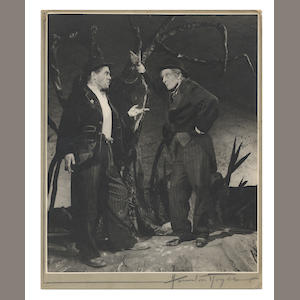
Pictures of the 1955 production: 

First production in English. Imported from France, directed by Peter Hall at 24. Before Godot, English theater was dominated by drawing-room comedies. The theater’s purpose was to be morally and artistically uplifting to the masses. Scripts were censored by the Lord Chamberlain, except for shows put on by privately owned clubs. London had very little room for small avant-garde theaters due to this censorship.

Peter Hall was the new, young director of the Arts Theatre, with 347 seats and a cramped stage. He cast mostly young, unknown actors. To compensate for the sparse language, Hall provided atmosphere and context with the set, which focused on providing realism. The set included a raised bank with scraggy vegetation upstage, a substantial tree on the bank upstage right that looked like a gnarled oak. Stage left there was “a tar barrel, a rock and some pieces of stone, as if abandoned by road-menders” (Bradby 75). The tar barrel was a focal point for a lot of the action. The set was extensive enough that some critics misinterpreted it as Expressionist. The costumes were elaborate and theatrical. Estragon and Vladimiir wore pinstripe suits that had once been nice, Pozzo wore a checkered suit with a check waistcoat in different check, check overcoat, cravat, monocle and watch chain – a member of the aristocracy. Pozzo, Estragon and Vladimir wore bowler hats. Lucky wore a stovepipe hat and was dressed as a porter. Estragon and Vladimir were portrayed as tramps.

The play was seen as degrading, squalid, pretentious drivel. Critics worried about understanding the play. The audiences and actors were embarrassed by the long unnatural pauses. It nearly closed until Kenneth Tynan, a critic for The Observer, wrote that Godot “forced me to re-examine the rules which had hitherto governed the drama; and having done so, to pronounce them not elastic enough.”

The play’s religious implications were pointed up more in this production, for example, when the Boy is asked where Godot is, he points at the heavens.

Hall added background music by Bartok before the play began and at points in the show to “heighten the sense of strangeness and the feeling of dusk falling on an isolated country road” (75).

Bradby, David. Beckett: Waiting for Godot. Cambridge: Cambridge UP, 2001. Print.